Saturday, September 29, 2012

Pope Benedict Speaks with Artists


MEETING WITH ARTISTS
ADDRESS OF HIS HOLINESS BENEDICT XVI
Sistine Chapel
Saturday, 21 November 2009

Dear Cardinals,
Brother Bishops and Priests,
Distinguished Artists,
Ladies and Gentlemen,

With great joy I welcome you to this solemn place, so rich in art and in history. I cordially greet each and every one of you and I thank you for accepting my invitation. At this gathering I wish to express and renew the Church’s friendship with the world of art, a friendship that has been strengthened over time; indeed Christianity from its earliest days has recognized the value of the arts and has made wise use of their varied language to express her unvarying message of salvation. This friendship must be continually promoted and supported so that it may be authentic and fruitful, adapted to different historical periods and attentive to social and cultural variations. Indeed, this is the reason for our meeting here today. I am deeply grateful to Archbishop Gianfranco Ravasi, President of the Pontifical Council for Culture and of the Pontifical Commission for the Cultural Patrimony of the Church, and likewise to his officials, for promoting and organizing this meeting, and I thank him for the words he has just addressed to me. I greet the Cardinals, the Bishops, the priests and the various distinguished personalities present. I also thank the Sistine Chapel Choir for their contribution to this gathering. Today’s event is focused on you, dear and illustrious artists, from different countries, cultures and religions, some of you perhaps remote from the practice of religion, but interested nevertheless in maintaining communication with the Catholic Church, in not reducing the horizons of existence to mere material realities, to a reductive and trivializing vision. You represent the varied world of the arts and so, through you, I would like to convey to all artists my invitation to friendship, dialogue and cooperation.

Some significant anniversaries occur around this time. It is ten years since the Letter to Artists by my venerable Predecessor, the Servant of God Pope John Paul II. For the first time, on the eve of the Great Jubilee of the Year 2000, the Pope, who was an artist himself, wrote a Letter to artists, combining the solemnity of a pontifical document with the friendly tone of a conversation among all who, as we read in the initial salutation, “are passionately dedicated to the search for new ‘epiphanies’ of beauty”. Twenty-five years ago the same Pope proclaimed Blessed Fra Angelico the patron of artists, presenting him as a model of perfect harmony between faith and art. I also recall how on 7 May 1964, forty-five years ago, in this very place, an historic event took place, at the express wish of Pope Paul VI, to confirm the friendship between the Church and the arts. The words that he spoke on that occasion resound once more today under the vault of the Sistine Chapel and touch our hearts and our minds. “We need you,” he said. “We need your collaboration in order to carry out our ministry, which consists, as you know, in preaching and rendering accessible and comprehensible to the minds and hearts of our people the things of the spirit, the invisible, the ineffable, the things of God himself. And in this activity … you are masters. It is your task, your mission, and your art consists in grasping treasures from the heavenly realm of the spirit and clothing them in words, colours, forms – making them accessible.” So great was Paul VI’s esteem for artists that he was moved to use daring expressions. “And if we were deprived of your assistance,” he added, “our ministry would become faltering and uncertain, and a special effort would be needed, one might say, to make it artistic, even prophetic. In order to scale the heights of lyrical expression of intuitive beauty, priesthood would have to coincide with art.” On that occasion Paul VI made a commitment to “re-establish the friendship between the Church and artists”, and he invited artists to make a similar, shared commitment, analyzing seriously and objectively the factors that disturbed this relationship, and assuming individual responsibility, courageously and passionately, for a newer and deeper journey in mutual acquaintance and dialogue in order to arrive at an authentic “renaissance” of art in the context of a new humanism.

That historic encounter, as I mentioned, took place here in this sanctuary of faith and human creativity. So it is not by chance that we come together in this place, esteemed for its architecture and its symbolism, and above all for the frescoes that make it unique, from the masterpieces of Perugino and Botticelli, Ghirlandaio and Cosimo Rosselli, Luca Signorelli and others, to the Genesis scenes and the Last Judgement of Michelangelo Buonarroti, who has given us here one of the most extraordinary creations in the entire history of art. The universal language of music has often been heard here, thanks to the genius of great musicians who have placed their art at the service of the liturgy, assisting the spirit in its ascent towards God. At the same time, the Sistine Chapel is remarkably vibrant with history, since it is the solemn and austere setting of events that mark the history of the Church and of mankind. Here as you know, the College of Cardinals elects the Pope; here it was that I myself, with trepidation but also with absolute trust in the Lord, experienced the privileged moment of my election as Successor of the Apostle Peter.

Dear friends, let us allow these frescoes to speak to us today, drawing us towards the ultimate goal of human history. The Last Judgement, which you see behind me, reminds us that human history is movement and ascent, a continuing tension towards fullness, towards human happiness, towards a horizon that always transcends the present moment even as the two coincide. Yet the dramatic scene portrayed in this fresco also places before our eyes the risk of man’s definitive fall, a risk that threatens to engulf him whenever he allows himself to be led astray by the forces of evil. So the fresco issues a strong prophetic cry against evil, against every form of injustice. For believers, though, the Risen Christ is the Way, the Truth and the Life. For his faithful followers, he is the Door through which we are brought to that “face-to-face” vision of God from which limitless, full and definitive happiness flows. Thus Michelangelo presents to our gaze the Alpha and the Omega, the Beginning and the End of history, and he invites us to walk the path of life with joy, courage and hope. The dramatic beauty of Michelangelo’s painting, its colours and forms, becomes a proclamation of hope, an invitation to raise our gaze to the ultimate horizon. The profound bond between beauty and hope was the essential content of the evocative Message that Paul VI addressed to artists at the conclusion of the Second Vatican Ecumenical Council on 8 December 1965: “To all of you,” he proclaimed solemnly, “the Church of the Council declares through our lips: if you are friends of true art, you are our friends!” And he added: “This world in which we live needs beauty in order not to sink into despair. Beauty, like truth, brings joy to the human heart, and is that precious fruit which resists the erosion of time, which unites generations and enables them to be one in admiration. And all this through the work of your hands . . . Remember that you are the custodians of beauty in the world.”

Unfortunately, the present time is marked, not only by negative elements in the social and economic sphere, but also by a weakening of hope, by a certain lack of confidence in human relationships, which gives rise to increasing signs of resignation, aggression and despair. The world in which we live runs the risk of being altered beyond recognition because of unwise human actions which, instead of cultivating its beauty, unscrupulously exploit its resources for the advantage of a few and not infrequently disfigure the marvels of nature. What is capable of restoring enthusiasm and confidence, what can encourage the human spirit to rediscover its path, to raise its eyes to the horizon, to dream of a life worthy of its vocation – if not beauty? Dear friends, as artists you know well that the experience of beauty, beauty that is authentic, not merely transient or artificial, is by no means a supplementary or secondary factor in our search for meaning and happiness; the experience of beauty does not remove us from reality, on the contrary, it leads to a direct encounter with the daily reality of our lives, liberating it from darkness, transfiguring it, making it radiant and beautiful.

Indeed, an essential function of genuine beauty, as emphasized by Plato, is that it gives man a healthy “shock”, it draws him out of himself, wrenches him away from resignation and from being content with the humdrum – it even makes him suffer, piercing him like a dart, but in so doing it “reawakens” him, opening afresh the eyes of his heart and mind, giving him wings, carrying him aloft. Dostoevsky’s words that I am about to quote are bold and paradoxical, but they invite reflection. He says this: “Man can live without science, he can live without bread, but without beauty he could no longer live, because there would no longer be anything to do to the world. The whole secret is here, the whole of history is here.” The painter Georges Braque echoes this sentiment: “Art is meant to disturb, science reassures.” Beauty pulls us up short, but in so doing it reminds us of our final destiny, it sets us back on our path, fills us with new hope, gives us the courage to live to the full the unique gift of life. The quest for beauty that I am describing here is clearly not about escaping into the irrational or into mere aestheticism.

Too often, though, the beauty that is thrust upon us is illusory and deceitful, superficial and blinding, leaving the onlooker dazed; instead of bringing him out of himself and opening him up to horizons of true freedom as it draws him aloft, it imprisons him within himself and further enslaves him, depriving him of hope and joy. It is a seductive but hypocritical beauty that rekindles desire, the will to power, to possess, and to dominate others, it is a beauty which soon turns into its opposite, taking on the guise of indecency, transgression or gratuitous provocation. Authentic beauty, however, unlocks the yearning of the human heart, the profound desire to know, to love, to go towards the Other, to reach for the Beyond. If we acknowledge that beauty touches us intimately, that it wounds us, that it opens our eyes, then we rediscover the joy of seeing, of being able to grasp the profound meaning of our existence, the Mystery of which we are part; from this Mystery we can draw fullness, happiness, the passion to engage with it every day. In this regard, Pope John Paul II, in his Letter to Artists, quotes the following verse from a Polish poet, Cyprian Norwid: “Beauty is to enthuse us for work, and work is to raise us up” (no. 3). And later he adds: “In so far as it seeks the beautiful, fruit of an imagination which rises above the everyday, art is by its nature a kind of appeal to the mystery. Even when they explore the darkest depths of the soul or the most unsettling aspects of evil, the artist gives voice in a way to the universal desire for redemption” (no. 10). And in conclusion he states: “Beauty is a key to the mystery and a call to transcendence” (no. 16).

These ideas impel us to take a further step in our reflection. Beauty, whether that of the natural universe or that expressed in art, precisely because it opens up and broadens the horizons of human awareness, pointing us beyond ourselves, bringing us face to face with the abyss of Infinity, can become a path towards the transcendent, towards the ultimate Mystery, towards God. Art, in all its forms, at the point where it encounters the great questions of our existence, the fundamental themes that give life its meaning, can take on a religious quality, thereby turning into a path of profound inner reflection and spirituality. This close proximity, this harmony between the journey of faith and the artist’s path is attested by countless artworks that are based upon the personalities, the stories, the symbols of that immense deposit of “figures” – in the broad sense – namely the Bible, the Sacred Scriptures. The great biblical narratives, themes, images and parables have inspired innumerable masterpieces in every sector of the arts, just as they have spoken to the hearts of believers in every generation through the works of craftsmanship and folk art, that are no less eloquent and evocative.

In this regard, one may speak of a via pulchritudinis, a path of beauty which is at the same time an artistic and aesthetic journey, a journey of faith, of theological enquiry. The theologian Hans Urs von Balthasar begins his great work entitled The Glory of the Lord – a Theological Aesthetics with these telling observations: “Beauty is the word with which we shall begin. Beauty is the last word that the thinking intellect dares to speak, because it simply forms a halo, an untouchable crown around the double constellation of the true and the good and their inseparable relation to one another.” He then adds: “Beauty is the disinterested one, without which the ancient world refused to understand itself, a word which both imperceptibly and yet unmistakably has bid farewell to our new world, a world of interests, leaving it to its own avarice and sadness. It is no longer loved or fostered even by religion.” And he concludes: “We can be sure that whoever sneers at her name as if she were the ornament of a bourgeois past – whether he admits it or not – can no longer pray and soon will no longer be able to love.” The way of beauty leads us, then, to grasp the Whole in the fragment, the Infinite in the finite, God in the history of humanity. Simone Weil wrote in this regard: “In all that awakens within us the pure and authentic sentiment of beauty, there, truly, is the presence of God. There is a kind of incarnation of God in the world, of which beauty is the sign. Beauty is the experimental proof that incarnation is possible. For this reason all art of the first order is, by its nature, religious.” Hermann Hesse makes the point even more graphically: “Art means: revealing God in everything that exists.” Echoing the words of Pope Paul VI, the Servant of God Pope John Paul II restated the Church’s desire to renew dialogue and cooperation with artists: “In order to communicate the message entrusted to her by Christ, the Church needs art” (no. 12); but he immediately went on to ask: “Does art need the Church?” – thereby inviting artists to rediscover a source of fresh and well-founded inspiration in religious experience, in Christian revelation and in the “great codex” that is the Bible.

Dear artists, as I draw to a conclusion, I too would like to make a cordial, friendly and impassioned appeal to you, as did my Predecessor. You are the custodians of beauty: thanks to your talent, you have the opportunity to speak to the heart of humanity, to touch individual and collective sensibilities, to call forth dreams and hopes, to broaden the horizons of knowledge and of human engagement. Be grateful, then, for the gifts you have received and be fully conscious of your great responsibility to communicate beauty, to communicate in and through beauty! Through your art, you yourselves are to be heralds and witnesses of hope for humanity! And do not be afraid to approach the first and last source of beauty, to enter into dialogue with believers, with those who, like yourselves, consider that they are pilgrims in this world and in history towards infinite Beauty! Faith takes nothing away from your genius or your art: on the contrary, it exalts them and nourishes them, it encourages them to cross the threshold and to contemplate with fascination and emotion the ultimate and definitive goal, the sun that does not set, the sun that illumines this present moment and makes it beautiful.

Saint Augustine, who fell in love with beauty and sang its praises, wrote these words as he reflected on man’s ultimate destiny, commenting almost ante litteram on the Judgement scene before your eyes today: “Therefore we are to see a certain vision, my brethren, that no eye has seen, nor ear heard, nor the heart of man conceived: a vision surpassing all earthly beauty, whether it be that of gold and silver, woods and fields, sea and sky, sun and moon, or stars and angels. The reason is this: it is the source of all other beauty” (In 1 Ioannis, 4:5). My wish for all of you, dear artists, is that you may carry this vision in your eyes, in your hands, and in your heart, that it may bring you joy and continue to inspire your fine works. From my heart I bless you and, like Paul VI, I greet you with a single word: arrivederci!

Dear friends, thank you for your presence here today. Let the beauty that you express by your God-given talents always direct the hearts of others to glorify the Creator, the source of all that is good. God’s blessings upon you all!


© Copyright 2009 - Libreria Editrice Vaticana

Sunday, May 27, 2012

deadNdisorderly


Today I introduce to you "The dNd"!
DeadNdisorderly is a Tumblr log affiliated with Quantum Cathedral via moderator.


There one can get their daily boost of wisdom from rowdy dead guys (and gals).
With a distinct affinity for the Chesterbelloc, all things Catholic and politically incorrect, take some time to check it out and perhaps subscribe.

Cheers!

Sunday, April 29, 2012

Never Take That Tone With Your Mother!

A dear friend of mine just sent me a book that he has been enjoying. I was able to begin reading it last night and I must say, I am greatly enjoying it! When a student at the Franciscan University in Steubenville recommends a book...read it.

In this case I opened an Amazon box to find "The Lord" by Romano Guardini inside. After a brief moment of panic in which I was convinced I had somehow managed to order a book in my sleep, I saw the gift note saying the volume was from a friend in Ohio. I laughed at myself.

Last night I was reading the chapter entitled "The Mother" and found myself being drawn in and engaged in the text more so than many books I have been reading lately. As I read I also noticed that the points being made were sparking additional revelations on the topic in my own mind. These all interwove to create for me a very warm and comfortable new understanding of the Blessed Mother. I want to speak of it here because half of the revelation happened between the lines and when I go back to reread the chapter in the future, I am noticing that without notes, 50% of what I "read" there will have dissipated.

The opening paragraph is beautiful:

"Anyone who would understand the nature of a tree, should examine the earth that encloses its roots, the soil from whch its sap climbs into branch, blossom, and fruit. Similarly to understand the person of Jesus Christ, one would do well to look to the soil that brought him forth: Mary, his mother." (Guardini,10)

He goes on to say that, "Mary's destiny was shaped by that of her child."
With this simple statement it occurred to me that Her whole existance, through and through, was one of humility. She no longer lived, if that had ever been her view(which I doubt), for her own ambition or personal fulfillment, but rather to nurture and mother the Child-God. Simeon had prophesied that her soul would be sword-pierced as she journeyed along the road that was being the mother of the Logos. Many authors and scholars with more clout than I, have examined and reflected upon the handful of passages in scripture in which Holy mother and Divine son interact. Often the observation is that the very otherworldlyness and seeming aloofness of Jesus' words, to and about his own mother, must have been one of the many sorrows Mary endured and accepted with peace and humility as part of the nature of being the Christ's mother. Guardini speaks of the interaction upon the finding of the child in the temple as follows. "Not understanding [Jesus], she buries the words like precious seed within her. The incident is typical: the mother's vision is unequal to that of her son, but her heart, like chosen ground, is deep enough to sustain the highest tree."

In looking at the words Jesus speaks to his mother, it is hard not to hear a bit of an attitude or superiority in the way he phrases things. "How is it that you sought me? Did you not know I must be about my Father's business?" Okay, it sounds a bit snotty. Honestly. Usually I skip past the matter with the conclusion that I must be missing something in order to understand why Mary didn't slap his little divine face for the seemingly disrespectful comment. Obviously we are dealing with two more nobel people than I. However, in reading this new book of mine, it suddenly occurred to me that the whole matter hinged on "tone".

When I was younger I was forever getting in trouble with my mom for things I would say. It drove me crazy because the words I spoke should never have gotten me in trouble. However, I was constantly being told, " It's not what you said. It's HOW you said it." This drove me up a wall since I took the effort to pick diplomatic words that I thought would keep me OUT of trouble and was STILL getting in trouble. I was learning about that unruly beast, "Tone of Voice", mastery of which eludes teenagers everywhere for the greater part of their adolescence.

Look at the scene of the finding of the child Jesus in the temple from a new perspective. The only thing we will be changing is our perception of Christ's tone of voice. Mary and Joseph stumble into the temple area, short of breath, dusty, and in a panic. Mary's eyes may be a little red from weeping from worry. She sees her 12 year old boy, safe, sitting among a group of teachers. In Luke the scripture describes her as being astonished. WHich part of the situation has astonished her? I have never wondered about that before. Is she astonished that they found him in good health or that he apparently had never been in any distress himself? Was she astonished that he was safe all along? Was her surprise about where they found him or the circumstance? Was the astonishing part that he was interacting intelligently with the teachers, engaging them and even providing his own astonishing answers to their questions? Perhaps every aspect was astonishing, thus magnifying its affect.

Mary then asks him, "Son, why have you treated us so? Behold, in sorrow your father and I have been seeking you." Did she blurt this out in front of everyone? Or was this uttered in anguish, privately, as they drew him aside from the company of teachers in the temple? Do you see how this one aspect alone changes the tone of the conversation? We know his reply. "How is it that you sought me? Did you not know that I must be in my Father's house?"

Here is where I am given to pause the longest. It is not a rebuke. I would boldly venture to say that it is not even a mild scolding or even a strongly worded correction that he directed at Mary. In fact he probably ran to her embrace with unbridled affection right before or after his reply. I am torn between two interpretations of the CHrist child's tone in this instance. I can imagine him laughing in a deeply loving way and teasing his mother that if ever he was lost she should have thought to look for him in the temple(his Father's house) as a meeting point FIRST, not after three days of looking elsewhere. Though, it may be a second way of looking at it, based on the fact that Mary came away from the conversation "not understanding the saying which he spoke to them". Perhaps it was just an instance of loving misunderstanding. Perhaps what looks like a rebuke is Jesus attempting to explain the matter to his mother. With great affection he hopes she will understand the spiritual nature of his explanation. I can imagine him looking into her eyes longing for the bond between them as mother and son to kindle a natural understanding in her of the situation. Perhaps he is a little confused by her reaction, having thought she would understand what he had done, and chose, perhaps with a little sigh of resignation, the shortest and simplest explanation upon seeing that it all had not been comprehended. He went home and obeyed. Perhaps he had resolved, after the temple incident, not to cause his mother and foster father any more anxiety via impromptu forays into the mission of his heavenly Father until his appointed time to go forth full strength and full time.

All of these, however, are just my ponderings.


-Jesus, I trust in you.

Tuesday, January 17, 2012

???

I've censored the following, in protest of a bill that gives any corporation and the US government the power to censor the internet--a bill that could pass THIS WEEK. To see the uncensored text, and to stop internet censorship, visit: http://americancensorship.org/posts/39834/uncensor


████ ███████,
████████████ has ██████ and ██████ a ████████ for █████ ████████ for ████ ████ █████. God ███████ has ████████ ██████ █████ ███████ and the way the █████ █████ for ████ ██████ ████ ████. As an ████████ ███████ I am █████ ███████ to ████████ ███████ ██████ █████ ████ ████ ████████ for ████. I am ███████ to █████ ████ it is ██████ to ████ a pre-████ █████ ██████. It is ███████ █████████ to act ████ the ████████ of ██████████ ████████. █████████████ is bad ████████ and ████████ our ██████, █████, and █████████████. ██████████ sex is █████ and ████ █████ you ███████████ ███████. I can █████ say █████ ██████. █████ █████ ████ a day ████ it won't be ███████. Don't let ████ day be ██████ ████ █████.
█████ in █████ ██████.
████


Uncensor This

Censorship? In the USA?

I've censored the following, in protest of a bill that gives any corporation and the US government the power to censor the internet--a bill that could pass THIS WEEK. To see the uncensored text, and to stop internet censorship, visit:
http://americancensorship.org/posts/39834/uncensor


████ ███████,
████████████ has ██████ and ██████ a ████████ for █████ ████████ for ████ ████ █████. God ███████ has ████████ ██████ █████ ███████ and the way the █████ █████ for ████ ██████ ████ ████. As an ████████ ███████ I am █████ ███████ to ████████ ███████ ██████ █████ ████ ████ ████████ for ████. I am ███████ to █████ ████ it is ██████ to ████ a pre-████ █████ ██████. It is ███████ █████████ to act ████ the ████████ of ██████████ ████████. █████████████ is bad ████████ and ████████ our ██████, █████, and █████████████. ██████████ sex is █████ and ████ █████ you ███████████ ███████. I can █████ say █████ ██████. █████ █████ ████ a day ████ it won't be ███████. Don't let ████ day be ██████ ████ █████.
█████ in █████ ██████.
████
Peace,
Anna

http://americancensorship.org/posts/39834/uncensor

Sunday, September 25, 2011

New Category... Things My friend Henry says...

Things Henry says...

"Gay priest jokes
are like shooting minnows
in an 8 once cup
using a howitzer
at point blank range."

Not much left to say about that. " :)

Tuesday, September 13, 2011

From the Inside Looking Out

(A piece of writing which attempts to convey to others what the phenomenon of trauma, PTSD, and brain injury feels like from the victim's perspective.)


Soul Crashes and Dark Nights of the Car

I’m an injured person. We are all injured people, however it manifests itself in different ways in each life. I’d like you to know that I too am an injured person and even perhaps a bit more injured than you. A few years ago I could have been just another dead twenty-something year old Catholic saint; without the saint part. I have a brain injury. Things just don’t connect quite right upstairs. However, despite this I have a Mensa level IQ. It is hard feeling dumb when you are not. It wasn’t my fault. The accident. It is not like I was drunk or high or even being stupid. I’m twenty-something, not stupid. I’m not stupid. I was rear ended. Terror. Noise. Blackness. Hypergosia. Things haven’t been the same. It’s hard feeling dumb when you are not. It’s worse feeling crazy when you are not. I knew I wasn’t dumb. I wasn’t so sure I wasn’t crazy.


When you are young you trust doctors. Doctors know what they are doing. Doctors have your best interest at heart. Trust doctors. Doctors are adults. Adults know what they are doing. But why do some of these doctors look the same age as me? Doctors are supposed to be adults. I don’t feel like an adult. Why don’t I feel like an adult? The doctors said there was nothing wrong with me. That is wrong. Wrong. Wrong. I feel wrong. They make me feel crazy. Am I crazy? I am not crazy, though I felt crazy for a while. For a while the doctors all told me I was fine. I am not fine. I’m anything BUT fine. I’ll never, never, never be fine again. I’m NOT FINE! No one listens. The doctors say I am fine. It’s hard feeling dumb when you are not. I felt dumb. I felt crazy. Alone. Dumb and crazy…and all alone. Alone, so very alone. And crazy. Crazy alone. Alone, alone, alone. Lonely. Crazy. Confused. So confused. I don’t understand. Maybe I am dumb. Crazy. Crazy, crazy. Crazycrazycrazycrazycrazycrazy. It hurts.


Confession is like a giant Band-Aid. The priest says it sounds like trauma, not crazy. He knew I wasn’t crazy. I’m glad somebody knew. I sure didn’t. A new doctor discovered the brain injury. Perhaps crazy is off the table now.


Damage to the brain is permanent. That is what I have learned. That’s a pretty bum deal since it wasn’t my fault. They say the key is therapy. Therapy to work around it. To learn to do old things in new ways. It still sucks. I also realize that I am BORED out of my mind. NOT crazy. Lonely. Bored and lonely. So very alone. I know what Chesterton said about being crazy. Thinking that I am crazy proves that I am not. I may be a little crazy, like everybody, but not in THAT way. I’ve done Gilbert proud. My head in the clouds but not clouds in my head. Unless you count the brain injury. There things feel a bit cloudy. But THAT is okay now too. A holy Polish priest prayed over me one day and the fog in my head stays mostly dissipated now. Then suddenly I remember how lonely I feel. I sometimes want the fog back. No one understands. People get angry and frustrated with me when they don’t understand. That isn’t fair. It’s not my fault. Why don’t they remember it is not my fault.


I’m trying to be normal. I’m pretty good at acting. This may be the biggest role of my life… playing “normal”. I don’t think it’s working very well. They still look at me… like THAT. I wish they wouldn’t look at me like that. It’s not my fault. It’s not my fault. I’m trying to be normal. It’s NOT my fault! I wish they wouldn’t look at me. Not if they are going to look at me like that. If I avoid them, then I won’t have to see them looking at me. Looking at me with their pity written all over their face. Looking at me…like an object…like something…something broken. Something less. Less than themselves. I’d like to shove their pity up their nose! But their expressions, they brand me. It hurts and all I want to do is cry. People should not be allowed to wear expressions that make people cry. So I don’t look. I don’t talk. I just follow with my head down and my hair falling out.


There is another sort of look. One I dread more. I shudder. I don’t like thinking of it. It’s worse than pity. Pity, at least, is a twisted sort of love. Maybe. I don’t know. I can pretend. But that annoyance… that frustration, it inevitably spews anger all over. I hate that the most. I hate it. I am not trying to be annoying. It is not fair to be annoyed at me. I’m trying not to be in the way. I’m trying not to be a pain. I’m trying not to be so broken. I’m trying very hard to be normal and to speak straight and to not burst into tears and not jump at sudden noises or flinch when people touch me or zone out when I’m overwhelmed! I try to stifle my panic when you all drive too fast or brake too fast or turn too fast. I know the passenger side brake pedal is broken. I know, but I can’t help using it. I can’t help it. It is not fair to be annoyed. It is not fair to be angry at me. It’s not my fault. It’s not my fault. I’m not crazy. It’s not my fault. Don’t be angry. Don’t make me feel like a burden. Forgive me for throwing paint brushes at you. You frightened me. I can’t handle your anger. It is not fair to be angry. It makes me frightened and ashamed. It makes it hard to remember that “ashamed” is wrong. Because it is not my fault. And I am NOT crazy. I’m just broken.


Unfortunately, I have learned that being broken is the worst thing to be if you are American. Broken is the ultimate evil. Broken gets in the way of efficiency. It gets in the way of fun. It gets in the way of fun fuzzy feel good fictions. Brokenness destroys fictions. People don’t like their fictions destroyed. They would rather destroy the broken. Or make them go hide themselves away. But I know a secret. You are all broken too. Hypocrites. You are all broken too, yet you shove each other out of the way to be able to throw the first stone at me. Just because I can’t hide my “broken”. Just because my “broken” shows. I have another secret though. I am probably smarter than most of you fiction addicts. I am not stupid. I am VERY much not stupid. Go flush your stupid annoyed angry faces down a toilet. You make me sick.


I am lonely. I miss my best friend. I can’t even remember when we stopped talking. She doesn’t know about how I almost died. She doesn’t know about the brain injury. She just stopped calling. Then stopped visiting. Then I gave up on trying to reconnect. Perhaps I am glad she isn’t around to see the difference having a cracked brain makes. I’m not who I would have said myself was. And when I say that I miss my best friend, I am not entirely sure if I mean her or the One I used to go visit in the chapel. He is another victim of the accident. I can’t bring myself to go there anymore. I don’t know why. Maybe I don’t want to know why. But I do miss Him. Sunday’s are just so formal. What is wrong with me? Please don’t answer that.


My friend walked away! I can’t DO this alone! Was there something wrong with me? The cracked brain came AFTER. If I wasn’t worth knowing anymore, then I’m really screwed now. I don’t smile anymore. I noticed that. I never smile. There is no levity. I never even feel the urge to laugh. Nothing is funny. My brain is cracked and I’m terribly lonely. I am not crazy, but tell that to my parents. I hate my life. My best friend ran away and I can no longer face the man in the chapel. Why didn’t he save me? I can’t DO this alone!


I seem to have traded all my smiles for tears. And my hair is falling out. Two things can be counted on; my hair falling out all over everywhere, and my tendency to burst into tears. It wasn’t my fault, but I’m stuck with this forever. The friends that are left won’t say it to my face, but I have changed… and it is awkward. Scars in my soul. Scars in my head. Scars on my arm. When did this happen? This cannot be me! This cannot be real! I don’t know who I am anymore! Will I wake up at any moment? It’s hard feeling dumb when you’re not. And the pain… it is just too much. Silence echoes from the heavens. And my hair is falling out!


And I’m bleeding. It frightens me. The doctor, the head injury guy, I told him. He said “hemorrhoids” and dismissed it. He was wrong. He was very wrong and it almost killed me. That came later. Later I found I was much more broken that I knew. More pain. So much more pain. I didn’t really know what broken meant until later. One’s body isn’t supposed to betray you. I don’t want to think about it. No. NO! Nonononononononono!


I’m avoided. I can’t do this alone. I am so tired of needing to be strong. So very tired of needing to be strong for myself. There is no one to be strong for me. I am so sick and tired of being sick and tired of being sick and tired. If I stop being strong… I’m afraid. I’m afraid to stop being strong. I have no choice. They all leave me alone, broken brain and all. I’m not crazy, but I’ve changed. I don’t recognize myself. No one notices, but there is a stranger in my head and it is me. There are cuts that no one notices. The presence in the silence is gone. It is hard to pray to an empty silence. Where did the living silence flee too? Did He flee from me? I’m sorry. Please come back. Don’t leave me too. Has He gone, or was He ever there? I no longer go to the chapel. I don’t know why. Or maybe I’m afraid that the silence there is empty also. I don’t want to have been mistaken. I can’t do this alone. He’s the only one I ever truly had. Oh God! Please be real!


There’s no one to talk to. It is too hard for some to face. The difference. The difference is too much for them and I often can’t figure out the words. The thoughts are still there, but the words come out funny, if at all. I’m an inmate in my own skull. If eyes are windows does ANYONE see the prisoner staring out? There is no way to escape it. I’m lonely and scared. More scared than ever before. Mothers know. Mom says I’m not used to being the broken one, the small one. My prolific pen was quit speaking. My journal lays empty. Perhaps she is right.


Why don’t I draw anymore? Why is the silence so empty? Why does the world punish the innocent? Why does our spirit remind us that we are not so innocent? And the silence, THE WRETCHED SILENCE IS SOO EMPTY! I cannot take anymore emptiness. I am filled up to the top with it. The silence has never been empty before. Does God take vacations? If angels were allowed to plug my ears and screen my eyes, is THIS how the world would seem? So, so very empty?


I’m stuck in the stream of time and the world swirls in eddies around me. Past me. I am stuck. There is a broken clock in my head. I feel no older than the day the car struck. Years trickle down the drain and if I blink I might miss it all.

I can’t sleep.

Thursday, August 25, 2011

Time Off

I am taking a vacation from blogging until certain projects are finished.
God Bless!

Tuesday, July 26, 2011

Double Standard: Assaults Ignored

Just one example of violence inflicted on peaceful pro-life protesters by pro-choice supporters.
A majority of incidents of violence between these two groups is inflicted by persons of pro-choice attitudes, but when was the last time anyone heard a report about this on the news?

This month in New Mexico, a pro-choice woman attacked some pro-life protesters, using her car keys as a weapon she inflicted a deep bleeding gash on one man's head. The violence was caught on video. Her car license plate number was noted and the police were called. By the time the video was posted to the site www.prochoiceviolence.com there had still been no responce by the police to the issue of this assault. Since then the woman has indeed been summoned to court to answer for assault and battery charges and a local news station ran a brief clip of the story. That is more news coverage than most violence against pro-life activists receives.

See the video that the national news media ignored: HERE.

Sunday, July 17, 2011

I'm Here... Where Is My Mammogram?


Planned Parenthood claims they provide essential basic health care services to poor and underprivileged women.

Just TRY to find a Planned Parenthood in your area that actually offers the "essential" services (like mammograms) that they say they offer. There is a video you need to see.

Planned Parenthood and Mammograms

.

Monday, July 11, 2011

Let's Discuss Modesty...

Reader discretion advised.


While surfing the web I recently came across an unsavory practice called "Bubbling".
It shocked me, but soon my brain saw how it can be used to illustrate an important point about the importance of modesty.

First of all an art instructor recently commented on how modern people undervalue the language of clothing. How a person dresses communicates to their viewer. Blindly following certain fashion trends is like parroting the words of another person without thinking of the content first.

Thus, the topic of modesty.

Most (I'd love to say "all") sane women would never go window-shopping downtown in nothing but their bra and underwear.
However, a large percentage of these same women don't blink twice when wearing a bikini to a beach.

What is the difference? Not much.
Really the only difference is that it has become socially acceptable to be unclad at beaches, but it is still considered "crude" to do so in town.

So what is the problem?
Men and women are different and the way their brains work follows suit.

Now I'd like to come back to where I started with the phenomenon of "Bubbling".
The pictures will explain what it is and why it is called what it is called.

Also, I'd like to postulate that this is (more or less) a pretty accurate example of the difference between the male and female view on the language of modesty (or lack of).

The girls see themselves "as is". This is to say, what the photo reveals is the image they are conscious of presenting to the world.


However, the current practice that some guys are using called "bubbling" reveals how the male brain (in most cases) is ACTUALLY seeing these girls.


Now, these are the SAME photos. In fact nothing at all has been subtracted from the scene. In fact, one could argue that more skin is covered up in the second set of photos.
However, most girls would be horrified if they saw "bubbled" photos of themselves.

Many parents have no problem with their teenage girls wearing bikinis. However I would bet that those same parents would have a very strong negative reaction to seeing their bikinied children in a "bubbled" photo.

I would hope that ANY female would be deeply disturbed by the fact that an innocent photo taken of them at the beach can be turned into soft porn without their knowledge.

Might I point out that the simple act of wearing even a one piece bathing suit makes it harder for your image to be abused and much easier for onlookers to maintain custody of their eyes. Though, even then, it still results in a somewhat uncomfortable image when "bubbled".


It is food for thought.
Perhaps we need to think about it more often.

Thursday, July 7, 2011

Visual Exploration of The Creative Process


Compliments of Brain Pickings...
#1

#2

#3

I can soooo relate to these. :)

Monday, July 4, 2011

The Mystical Beauty of Iconology

Forgive the lack of posts last month. I have been out of town a lot this summer.

One such vacation was spent for a week at an iconography retreat up north conducted by the Prosopon School of Iconology. I have been awestruck by the profound depth of meaning put into these images. I feel compelled to look into the obvious and exciting connections between inconology and the Theology of the Body.

As I discover and enrich my own understanding of this breathtaking art I will share my observations with you.

For now, here is the image of my finished icon from the retreat.

Sunday, June 26, 2011

My New Favorite Tea

I picked up a new tea today and I am declaring it my current favorite.

Organic Guayaki brand Yerba Mate. Mate Chocolatte flavor.
It contains yerba mate leaf, cocoa seed, nutmeg, cinnamon, stevia leaf, and clove.
Mmmmmmm.

The taste reminds me of Ukrainian Christmas. This is because the taste is remisicint of "Kutia" – a Christmas dessert with honey, nuts, poppy seeds and wheat/buckwheat.

Monday, June 6, 2011

Please Cry

I don't always agree with the articles on Psychcentral.com, but this one was worth the read.

7 Good Reasons to Cry: The Healing Property of Tears

By Therese J. Borchard
Associate Editor

7 Good  Reasons to Cry: The Healing Property of TearsNew York Times reporter Benedict Carey referred to tears in a piece as “emotional perspiration.” Given that I sweat a lot and hate deodorant, I suppose it makes sense that I weep often. But I’m not going to apologize for that, because after a good cry, I always feel cleansed, like my heart and mind just rubbed each other’s backs in a warm bath.

In his intriguing article, “The Miracle of Tears”, from which I’ve borrowed some of the research for this post, author Jerry Bergman writes: “Tears are just one of many miracles which work so well that we taken them for granted every day.” Here, then, are seven ways tears and the phenomenon we call “crying” heal us physiologically, psychologically, and spiritually.

1. Tears help us see.

Starting with the most basic function of tears, they enable us to see. Literally. Tears not only lubricate our eyeballs and eyelids, they also prevent dehydration of our various mucous membranes. No lubrication, no eyesight. Writes Bergman: “Without tears, life would be drastically different for humans — in the short run enormously uncomfortable, and in the long run eyesight would be blocked out altogether.”

2. Tears kill bacteria.

No need for Clorox wipes. We’ve got tears! Our own antibacterial and antiviral agent working for us, fighting off all the germs we pick up on community computers, shopping carts, public sinks, and all those places the nasty little guys make their homes and procreate. Tears contain lysozyme, a fluid that the germ-a-phobic dreams about in her sleep, because it can kill 90 to 95 percent of all bacteria in just five to 10 minutes! Which translates, I’m guessing, to three months’ worth of colds and stomach viruses.

3. Tears remove toxins.

Biochemist William Frey, who has been researching tears for as long as I’ve been searching for sanity, found in one study that emotional tears–those formed in distress or grief–contained more toxic byproducts than tears of irritation (think onion peeling). Are tears toxic then? No! They actually remove toxins from our body that build up courtesy of stress. They are like a natural therapy or massage session, but they cost a lot less!

4. Crying can elevate mood.

Do you know what your manganese level is? No, neither do I. But chances are that you will feel better if it’s lower because overexposure to manganese can cause bad stuff: anxiety, nervousness, irritability, fatigue, aggression, emotional disturbance and the rest of the feelings that live inside my happy head rent-free. The act of crying can lower a person’s manganese level. And just like with the toxins I mentioned in my last point, emotional tears contain 24 percent higher albumin protein concentration — responsible for transporting many small molecules (which has to be a good thing, right?) — than irritation tears.

5. Crying lowers stress.

Tears really are like perspiration in that exercising and crying both relieve stress. For real. In his article, Bergman explains that tears remove some of the chemicals built up in the body from stress, like the endorphin leucine-enkaphalin and prolactin, the hormone I overproduce because of my pituitary tumor that affects my mood and stress tolerance. The opposite is true too. Bergman writes, “Suppressing tears increases stress levels, and contributes to diseases aggravated by stress, such as high blood pressure, heart problems, and peptic ulcers.

6. Tears build community.

In her “Science Digest” article, writer Ashley Montagu argued that crying not only contributes to good health, but it also builds community. I know what you’re thinking: “Well, yeah, but not the right kind of community. I mean, I might ask the woman bawling her eyes out behind me in church what’s wrong or if I can help her, but I’m certainly not going to invite her to dinner.”

I beg to differ. As a prolific crier, especially on video, I always come away astounded by the comments … the resounding support of people I know all that well, and the level of intimacy exchanged among them. Read for yourselves some of the comments on both my self-esteem video and my recent death and dying video and you’ll appreciate my point. Tears help communication and foster community.

7. Tears release feelings.

Even if you haven’t just been through something traumatic or are severely depressed, the average Jo goes through his day accumulating conflicts and resentments. Sometimes they gather inside the limbic system of the brain and in certain corners of the heart. Crying is cathartic. It lets the devils out. Before they wreak all kind of havoc with the nervous and cardiovascular systems. Writes John Bradshaw in his bestseller Home Coming: “All these feelings need to be felt. We need to stomp and storm; to sob and cry; to perspire and tremble.” Amen, Brother Bradford!

Source.

Friday, June 3, 2011

Be Satisfied With Me

Everyone longs to give themselves completely to someone,

to have a deep soul relationship with another,

to be loved thoroughly and exclusively.


But to a Christian, God says "No, not until you are satisfied,

fulfilled, and content with being loved by Me alone,

with giving yourself totally and unreservedly to Me,

with having an intensely personal and unique relationship with Me alone.

Discovering that only in ME is your satisfaction to be found

will you be capable of the perfect human relationship that I have planned for you.


You will never be united to another

until you are united with Me,

exclusive of anyone or anything else,

exclusive of any other desires or longings.

I want you to stop planning, stop wishing, and allow ME to give you

the most thrilling plan existing... one that you cannot imagine.

I want you to have the best!


Please allow Me to bring it to you.

You keep watching Me, expecting the greatest thing.

Keep experiencing the satisfaction that I am.

Keep listening and learning the things that I tell you.

Just wait, that's all.


Don't be anxious. Don't worry.

Don't look around at things the others have gotten

or that I have given to them.

Don't look around at the things you think you want.

Just keep looking off and away up to ME

or you'll miss what I want to show you.

And then, when you are ready, I will surprise you with a love

far more wonderful than you would ever dream.

You see, until you are ready and until the one I have for you is ready,

I am working even at this moment to have both of you ready at the same time,

until you are both satisfied exclusively with Me and the life I have prepared for you,

you wont be able to experience the love that exemplifies your relationship with Me.

And this is perfect love.


And, dear one, I want you to have this most wonderful love.

I want you to see in the flesh a picture of your relationship with Me,

and to enjoy materially and concretely the everlasting union of beauty, perfection,

and love that I offer you with Myself.

Know that I love you utterly.

For I am God. Believe it, and be satisfied.


~Author Unknown


Tuesday, May 31, 2011

Ideal Slacker Outfit of the Day

Get ready for the day.

First put your shirt on.


Affix mood appropriate button.


Fix your hair at least somewhat. Make it look like you tried.


Necklace...check.


Earrings...what?


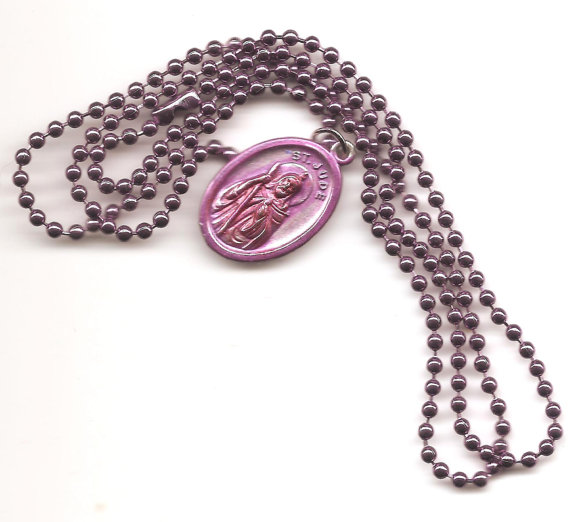
Patron of Lost Causes...why not. Can't hurt. :)


NOW we are ready for the day!!!

(You can most of these items on Etsy.com)

Sunday, May 29, 2011

A Family Should ADORE Together


A FAMILY OF SAINTS
Eucharistic Adoration Leads to Sanctification

"Remain in Him now, little ones, so that, when He reveals Himself, we may be fully confident and not retreat in shame at His coming. If you consider the holiness that is His, you can be sure that everyone who acts in holiness has been begotten by Him" (1 Jn. 3:28-29).

During her short life on this earth St. Thérèse of Lisieux was a 'little one.' Born January 2, 1873, Thérèse was the youngest child of 9 in the Martin family, 4 having died in infancy. Louis and Zelie had instilled a strong Catholic faith in their children, both in teaching and example. They attended daily mass and frequent adoration of the Blessed Sacrament, as a family. In addition, Louis belonged to the Nocturnal Adoration Society. They prayed at home daily, together, and had a great devotion to Our Lady. Zelie's greatest desire in life was that all of her children become Saints. Zelie became very ill and was so weak that she could not even open the Church door. She would go to Church and wait on the steps for someone to open the door so she could attend Mass and adoration of Jesus in the Most Blessed Sacrament. When Zelie died of cancer at age 45, little Thérèse was only 4 years old. Zelie left her children with their strong faith and love which carried them through their intense period of grief and mourning. Marie, Pauline, Leonie and Celine, Thérèse's older sisters, became her great consolation. Her Father, Louis Martin, tried to lovingly protect Thérèse and her sisters from the darkness of the world.


Painting by Celine Martin, sister of St. Therese

Little Thérèse grew very close to Our Lady, especially after her earthly mother went to heaven. Our Lady took this special little one by the hand and formed her into a beautiful spouse for her Son. When Thérèse was 14 years of age she went to Rome on a pilgrimage with her father and sister to see the Holy Father. She begged the Pope to allow her to enter Carmel, as a religious sister, even though the rules clearly stated that she had to be much older.

He told her not to worry, if it was God's will it would happen. Upon returning home, in thanksgiving to Jesus, her King, for the grace of the pilgrimage, she donated her gold bracelet to be part of a monstrance which would adorn Him from that time to the present. This monstrance is at Le Sacre Coeur in Montmartre, Paris, where they have Perpetual Eucharistic Adoration, which began during her life and still continues today--over a hundred years later!

When Thérèse entered Carmel, at age 15, she grew rapidly in the virtue of humility, the mother of all virtues. She quickly grew in wisdom and grace, so much so that she was appointed novice mistress a few years after she entered the convent. This little one with her little way grew in such holiness in such a short time that God soon called her home to heaven where she could adore Him perpetually for eternity, and do so much more to help save souls and bring them to Him. Thérèse died on September 30, 1897, at 24 years of age. She said "My mission--to make God loved--will begin after my death." Thérèse promised, "I will spend my heaven doing good on earth. I will let fall a shower of roses." To this day she still showers down countless roses on those who invoke her aid.

St. Thérèse, the Little Flower, is one of God's very special little ones indeed! She was an exceptionally gifted writer, poet, lyricist and artist. Yet, in spite of her many talents, it was her little way, which is so very powerful, that crowned her as a Doctor of the Church! Her little way is a way that anyone can follow, with God's grace. It is being small--humble, in being loving-- charitable, in being meek--docile, in being a little child of God. It is the way of salvation, the way of holiness, the way of Sanctity, the way of God!

St. Thérèse did not learn her little way by means of extensive travel, by attending great universities, or by reading scholarly books. She learned this little way at the feet of Jesus in the most Blessed Sacrament (Whom she spent several hours with each day): by praying, meditating and contemplating His real presence in the Sacred Host, and by pondering His words in scripture, the book of love, as she called it. He gave her all she needed, and more, so that she could love and serve others not only in her monastery but in the whole world. Those who have read her autobiography, The Story of A Soul, know how she prayed, sacrificed and aided in the salvation of numerous souls while she was on this earth. At one time during her life, she wanted to be a missionary and travel to China, and many other countries, to help save souls. She did exactly that, not by traveling, but by offering up all of the routine, daily little prayers, penances and sacrifices for the success of the work of the missionaries and the salvation of souls. She did such an outstanding job that she has the title of Co-Patroness of the missions, with St. Francis Xavier! She is also Co-Patroness of France along with her patroness St. Joan of Arc!

St. Thérèse of Lisieux is a Saint that we can all try to emulate. Her little way can be our little way; it is within our reach. We can offer up all of our daily annoyances, inconveniences, trials, disappointments, things that we don't like doing and so forth, for the love of God and others--for the salvation of souls.

St. Thérèse is also a tremendous witness to the great importance of Holy Families. Her faith was born of the strong Catholic faith and the daily living of it, which came from her parents. They are role models for Catholic parents today. As parents, both biological and spiritual, we need to keep God's design for us and our children foremost in our minds, hearts and lives. That design is no less than Sanctity for each one of us and our children, and all of His children!

St. Thérèse said of her parents "God gave me a father and a mother more worthy of heaven than of earth." Louis and Zelie did such an outstanding job as parents and were so holy that both of their causes for beatification are being considered. All five of their daughters became religious sisters. Strengthened by The Eucharist Louis and Zelie inspired and led Therese, and her sisters, along the path of Sanctity. Some of their other daughters are also being considered for beatification!

These times in which we live are surely not enveloped in any less darkness than the time of the Martin family. Let us invoke the intercession of St. Thérèse, and her family, for our own salvation and that of our families, indeed the salvation of the whole family of God. She is still doing a tremendous amount of good on earth. She will intercede for us and continue to shower down roses from heaven!

St. Thérèse is the patroness of missionaries, although she never left her convent. She died at the early age of 24, yet accomplished great things through the power of prayer before Jesus in the Blessed Sacrament. The Church made her the patroness of missionaries to emphasize this most important truth: one soul coming before the Blessed Sacrament can change the world! "There is only one thing to do here below, to love Jesus, to win souls for Him that He may be loved"
(St. Thérèse). (Copyright 1999, L. Bracy. All rights reserved).

Angel of my Eucharist
It is you who will delight my heart
Yes, it is your sweet melody
That will console my sorrow.
I thirst to give myself to souls
But too many hearts are indifferent
Seraphim, give them your flames
Bring them with your sweet songs.
I would like the soul of the Priest

To look like the heavenly Seraphim!
I would like him to be born anew
Before going up to the Altar!

In order to obtain this miracle
Some souls near the tabernacle,
Praying unceasingly,
Should offer themselves to me every day.
(Words of Jesus from a play by St. Thérèse)


Painting by St. Thérèse of the Child Jesus and the Holy Face

“By our little acts of charity practiced in the shade we convert souls far away, we help missionaries, we win for them abundant alms; and by that means build actual dwellings spiritual and material for our Eucharistic Lord.” (St. Thérèse)

Home link

St. Therese and Healing of Broken Hearts

Words of St. Therese

Therese Palette Lisieux

Therese's painting palette

If a piece of canvas painted upon by an artist could think and speak, it certainly would not complain at being constantly touched and retouched by the brush, and would not envy the lot of that instrument, for it would realize it was not to the brush but to the artist using it that it owed the beauty with which it was clothed. The brush would not be able to boast of the masterpiece produced with it, as it knows that artists are not at a loss; they play with difficulties, and are pleased to choose at times weak and defective instruments.

I am a little brush which Jesus has chosen in order to paint His own image in the souls entrusted to my care. An artist does not use only one brush, but needs at least two: the first is the more useful and with it he applies the general tins and covers the canvas entirely in a very short time; the other, the smaller one, he uses for details.

Our Prayer

Good Jesus, Artist of our Souls, we need Your healing touch. Disappointments, disillusionment and betrayals have discolored our soul. We are brokenhearted because we expect so much; we sense the the beautiful portrait of our life has been ruined. We have lost faith in ourselves as Your dwelling place and Your image – as the canvas where You are painting beauty.

We don’t let your inclusive and colorful love define us. We let hurts and anger harden our hearts, and transmit them to others. Our self-pity explodes in self-destructive ways or in violent attitudes, judgments, words and silence toward others. In the heavy emptiness of our hearts, we let power, privilege, prestige and plenty define us and justify our less-than-true selves.

Like St. Therese, help us transcend the heartbreaking disappointments of life and embrace the holy opportunities that are Your grace everywhere. Touch our brokenness, Lord Jesus. Your suffering and death opened You to God and the salvation of all. Transform the sufferings of our broken hearts into a deeper longing for You and a clearer vision of life in faith, with You as the Artist.

We ask You this, through the intercession of St. Therese, who teaches us confidence and trust in Your love.

Article by Fr. Bob here.